

AC repair is the diagnosis and correction of faults in a home’s cooling system — most commonly failed capacitors and contactors, refrigerant leaks, frozen evaporator coils, clogged condensate drains, and blower or control failures. Refrigerant work is legally restricted to EPA 608–certified technicians. Caught early these are short repairs; ignored, they progress to compressor failure.
An air conditioner rarely fails without warning. Longer run times, a room that stopped keeping up, a hum from the outdoor unit that wasn’t there last year — these are components drifting out of spec. Kansas summers leave little margin, and a marginal system usually gives out during the first stretch of hundred-degree afternoons.
Most no-cool calls come down to a handful of failures: a capacitor, a contactor, a refrigerant leak, a frozen coil, or a blocked condensate drain. Several of them look identical from inside the house — warm air at the vents tells you almost nothing about which one you have — which is why the diagnosis matters more than the symptom.
Professional AC Repair Services
Trusted cooling solutions across South Central Kansas since 2004.
Signs Your AC Needs Repair
| What You Notice | What it Usually Means | How Urgent |
|---|---|---|
| Air from the vents is warm | Thermostat setting, a refrigerant leak, or a frozen coil | Check the thermostat and filter, then call |
| Outdoor unit hums but the fan does not spin | A failed run capacitor — the most common AC failure | Shut it off and call; do not let it keep trying |
| Ice on the refrigerant line or indoor coil | Restricted airflow or low refrigerant | Turn it off to thaw, replace the filter, then call |
| Water pooling near the indoor unit | A clogged condensate drain | Shut it off to avoid ceiling or floor damage |
| Burning or hot-electrical smell | An overheating motor, contactor, or wiring | Shut off the breaker and call immediately |
| Runs constantly but never reaches setpoint | Low refrigerant, dirty coils, or a system past its life | Schedule a full evaluation |
R-410A and R-454B: What the Refrigerant Change Means
Under the EPA’s Technology Transitions Rule, issued under the AIM Act, manufacture and import of new residential AC systems using refrigerants above 700 GWP stopped January 1, 2025. R-410A sits at 2,088 GWP, which is why new equipment ships with R-454B or R-32.
R-410A is not banned. The rule restricted new equipment manufacture — not the refrigerant, existing stock, or servicing installed systems. If your system uses R-410A, keep it and service it normally. If a contractor tells you a working R-410A system must be replaced because of the rule, get a second opinion.
R-22 is a different situation. It was phased out earlier and is genuinely scarce, so a refrigerant leak on an R-22 system is a real repair-or-replace decision — driven by the refrigerant, not the age.
What We Repair
| Area | What We Handle |
|---|---|
| Electrical components | Capacitors, contactors, relays, control boards, disconnects, wiring faults |
| Refrigerant circuit | Leak detection and repair, recharge, metering device faults, compressor diagnosis |
| Airflow and coils | Coil cleaning, blower motor and wheel, frozen coil diagnosis, duct restrictions |
| Drainage | Condensate drain clearing, drain pan and float switch replacement |
| Controls and heat pumps | Thermostats, sensors, zoning, reversing valves, defrost boards |
What Affects the Scope of a Repair
Two calls with identical symptoms can be very different jobs. What drives the difference:
- Which component failed, and whether it is a stocked part or a special order
- Whether the fault is electrical, mechanical, or refrigerant-side
- The refrigerant the system uses — R-22 systems are materially harder to service
- System age and whether replacement parts are still manufactured
- Whether the failure has already damaged the compressor
- Accessibility of the air handler — attic, crawlspace, or closet
- Whether the underlying cause is the equipment or the duct system
That last one matters more than homeowners expect. A system that never quite keeps up is often not undersized — it is fighting restricted or badly balanced ductwork, and replacing the equipment alone will not fix it.
Where We Work
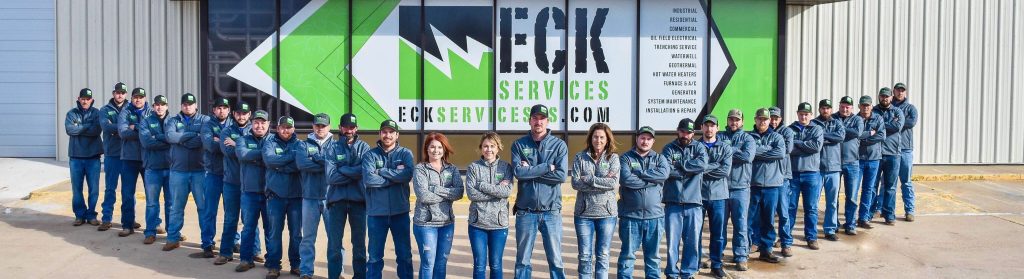
Licensed HVAC technicians dispatched from seven Kansas branches. Choose your city for local scheduling and response times.
Wichita · Hutchinson · Salina · Pratt · Kingman · Anthony · Medicine Lodge
Why Homeowners Choose Eck
Serving South Central Kansas since 2004. Kansas Mechanical License #10071, Lennox Premier Dealer, Mitsubishi Mini Split Dealer, BBB accredited A+, and named to the Inc. 5000 in 2019, 2020, and 2021.
- Locally owned, not a private-equity roll-up
- Licensed in mechanical, electrical, and plumbing — we diagnose the electrical side of an AC failure instead of referring it out
- Stocked trucks at all seven branches, so more repairs finish on the first visit
- After-hours emergency availability
Don’t Say What the Heck, Call Eck!
Schedule AC repair online or call your nearest branch. No-cool calls during extreme heat are prioritized.
Schedule Online
Frequently Asked Questions
Three causes cover most cases: the thermostat is set to heat or fan-only rather than cool, a refrigerant leak is preventing the system from absorbing heat, or a frozen evaporator coil is blocking airflow across the cold surface. Other suspects include a tripped breaker at the outdoor unit, a failed capacitor, or a filter choking airflow. Check the thermostat and filter first. If both are fine, shut the system off and call before the compressor is affected.
Freeze-ups come down to two things: restricted airflow — a dirty filter, closed registers, a failing blower, or a collapsed duct — or low refrigerant from a leak. When the evaporator coil drops too cold, condensation freezes; as the ice melts it overwhelms the drain pan and drips through ceilings or onto floors. Shut the system off so it can thaw, since running a frozen unit can damage the compressor, fit a clean filter, and book a service visit. A simple clogged condensate drain is a separate and much quicker fix.
Twelve to fifteen years for most central systems, somewhat less for heat pumps since they run year-round rather than seasonally. Kansas conditions push toward the lower end of that range — long cooling seasons, high dust and pollen loads, and cottonwood seed collecting on outdoor coils all add wear. A well-maintained system regularly outlasts a neglected one by several years, which is most of the argument for annual service. If yours is past fifteen and has needed repairs in consecutive seasons, it is worth evaluating before it fails rather than after.
Three things decide it, roughly in this order: age, refrigerant, and which component failed. A capacitor, contactor, blower motor, or control board on a system under about twelve years old is a repair. A compressor or evaporator coil failure on a system past fifteen — particularly one still running R-22 — is usually not worth chasing. Between those, repair history is the tiebreaker: a third service call in two seasons is a pattern rather than bad luck.