

Plumbing repair is the diagnosis and correction of a specific fault — a leak, a pressure drop, a fixture that will not stop running, a drain that keeps backing up, a pipe that split in a cold snap. It is distinct from replacement work: the goal is to find what failed and fix that, not to swap the system around it.
Plumbing problems come in two kinds: the ones that can wait for an appointment, and the ones where every minute costs you drywall. Knowing which you have — and where your main shutoff is — makes a substantial difference in how the day ends.
What the house is doing narrows it faster than what it looks like. A slow drain and a main line restriction present identically at the sink. A pressure drop on the hot side only and one across the whole house point at completely different parts of the system.
Shut the Water Off First
If water is running where it shouldn’t be, shutting it off comes before calling anyone. The main shutoff is usually where the supply enters the house — a basement wall, crawlspace, garage, or near the water heater. A gate valve turns clockwise several rotations; a ball valve is a quarter turn until the handle sits crosswise. Individual fixtures have their own stop valves under the sink or behind the toilet.
After a burst pipe: close the main, open the lowest faucet to drain pressure, shut off circuits near standing water, and turn off the water heater so it doesn’t fire on an empty tank.
Expert Plumbing Repair Services
Trusted plumbing solutions across South Central Kansas since 2004.
The Signs You Need A Plumber
| Symptom | Likely Cause | What to Do |
|---|---|---|
| Low pressure at one fixture | Clogged aerator or a partly closed stop | Clean the aerator — often fixes it entirely. |
| Low pressure throughout the house | Failing PRV, corroded galvanized pipe, or scale | Check the main is fully open, then call. |
| Rust-colored water | Corroding galvanized pipe or an aging water heater | Note if it’s hot, cold, or both — that narrows it. |
| Meter moves with everything off | An active hidden leak | Call. You’re losing water continuously. |
| Warm spot on a slab floor | A hot-side slab leak | Call promptly — the damage compounds. |
| Recurring sewer backups | Root intrusion or joint separation in the lateral | Ask for a camera inspection, not another clearing. |
| Several fixtures draining slowly at once | A main line restriction, not individual clogs | Call. Don’t use chemical drain cleaner. |
| Banging pipes when a valve closes | Water hammer or high system pressure | Have static pressure checked. |
Plumbing Code and Permits in Kansas
Kansas has no statewide plumbing code. Wichita and Sedgwick County adopted the 2021 Uniform Plumbing Code as their sole plumbing code effective January 1, 2022, ending a dual IPC/UPC arrangement in place since 2016. Most of the country is on the IPC, so a UPC-only jurisdiction is unusual — and it changes how work is designed, permitted, and inspected. Other jurisdictions we serve are on different codes and editions, and we confirm which applies before pulling a permit.
What We Repair
| Area | What We Handle |
|---|---|
| Leaks and Pipe Repair | Pinhole leaks, burst and frozen lines, slab leaks, hose bibs, leak location |
| Water Pressure | PRV replacement, corroded supply lines, whole-house pressure diagnosis |
| Drains and Sewer | Main line clears, hydro-jetting, camera inspection, spot and trenchless repair |
| Water Heaters and Fixtures | Tank and tankless repair, toilets, faucets, showers, disposals |
| Repiping and Emergency | Whole-home and partial repipe, active leaks, sewage backups, no water |
Frozen Pipes and Seasonal Risk
South Central Kansas regularly drops below 10°F. Pipes in crawlspaces, garages, exterior walls, and unheated utility rooms are the ones that freeze and split — and the damage usually shows up not when the pipe freezes but when it thaws and water starts moving again.
- Insulate exposed supply lines in crawlspaces, garages, and attics
- Disconnect garden hoses — a connected hose is the most common cause of a burst hose bib
- Shut off and drain exterior hose bibs where interior valves exist for them
- Seal air leaks where plumbing passes through exterior walls
- In extreme cold, let a faucet drip and open cabinet doors under sinks on exterior walls
Properties in low-lying areas face the opposite problem in spring. A working sump pump and maintained drainage are the main defense against basement water intrusion.
Where We Work
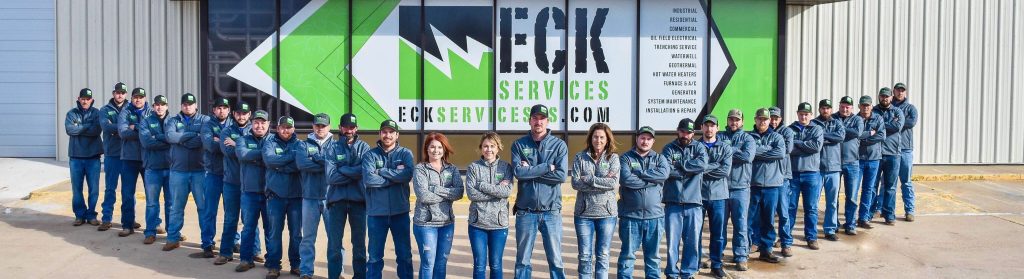
Licensed plumbers dispatched from seven Kansas branches, serving city water and rural systems including private wells and septic.
Wichita · Hutchinson · Salina · Pratt · Kingman · Anthony · Medicine Lodge
Why Homeowners Choose Eck
Serving South Central Kansas since 2004. Kansas Plumbing License #09852, BBB accredited with an A+ rating, and named to the Inc. 5000 in 2019, 2020, and 2021.
- Locally owned, not a private-equity roll-up
- Licensed in plumbing, electrical, and mechanical — water heater circuits, well pumps, and sump pump wiring handled on one visit
- Stocked trucks at all seven branches
- Permitted and inspected wherever the jurisdiction requires it
Don’t Say What the Heck, Call Eck!
Schedule plumbing repair online or call your nearest branch. If water is running, shut off the main first.
Schedule Online
Frequently Asked Questions
In rough order of likelihood: a clogged fixture aerator; a failing pressure reducing valve; a partly closed main shut-off valve, so turn it back; internally corroded galvanized piping; years of accumulated scale from hard water; a municipal main break or utility work, so call the water utility; or a hidden leak — listen at the meter with every fixture off. If only the hot side is weak, suspect the water heater dip tube or its shutoff valve.
For the repair itself, almost never — routine wear and tear is excluded from every standard homeowners policy. What is usually covered is the secondary damage from a sudden, accidental failure: a burst pipe flooding the kitchen, a ruptured water heater, a frozen line that splits. What is generally not covered: damage from slow or gradual leaks, sewer and drain backup without a rider, flooding from outside sources, which needs separate flood insurance, and damage attributable to deferred maintenance. In practice the repair comes out of pocket and insurance pays for the wet flooring and drywall.
The usual signs are a warm spot on the floor for a hot-side leak, the sound of running water with every fixture off, unexplained damp areas or lifting flooring, and a water meter that keeps moving when nothing is in use. Slab leaks do not resolve on their own and the damage compounds under the foundation, so locating one early matters. We use acoustic and pressure-based location rather than opening the slab to look.
Start with the fuel type. On a gas water heater, check whether the pilot or igniter is lit — that is the most common cause, and sometimes a relight is all it takes. On electric, check the breaker and the reset button on the upper thermostat. If neither applies, or you get hot water that runs out far faster than it used to, the usual culprits are a failed heating element, a broken dip tube, or sediment taking up tank volume. Those need service rather than a reset.