

Furnace Installation & Replacement
Furnace Installation & Replacement Across South Central Kansas

Furnace installation covers sizing, selecting, and installing a replacement heating system — including venting, gas piping, electrical connections, and commissioning. Correct sizing comes from an ACCA Manual J load calculation, not from matching the old unit. In most of Kansas, furnace replacement requires a permit and inspection, and high-efficiency condensing furnaces vent differently than the systems they replace.
Most furnace replacements happen one of two ways: planned in the fall, with time to compare equipment — or unplanned in January, with the house at 50 degrees. The first produces better outcomes. If your system is past fifteen years, has needed repairs two winters running, or is still an 80% AFUE unit, have it looked at before the season rather than during it.
Expert Furnace Installation & Replacement Services
Trusted heating solutions across South Central Kansas since 2004.
The 2028 Efficiency Standard and What It Changes
| Type | Today | From December 18, 2028 |
|---|---|---|
| Minimum AFUE, gas furnaces | 80% | 95% |
| Non-condensing furnaces | Available | Phased out of new manufacture |
| Typical venting | B-vent or masonry chimney | PVC through an exterior wall |
| Your existing furnace | Unaffected | Unaffected — the rule covers new equipment |
The Department of Energy raised the minimum efficiency for non-weatherized gas furnaces from 80% to 95% AFUE, with compliance required on and after December 18, 2028. New gas furnaces will be condensing units, which pull additional heat from the exhaust using a secondary heat exchanger.
Venting: The Part Most Homeowners Don’t Expect
A condensing furnace produces cool, acidic exhaust that cannot safely go up a masonry chimney or B-vent. Replacement in an older home means new PVC intake and exhaust through an exterior wall, plus a condensate drain.
It also raises the orphaned water heater problem. In many older homes the furnace and water heater share one flue, and the furnace produces most of the heat carrying both exhausts up and out. Remove the furnace and the water heater vents alone into a chimney far too large for it — exhaust cools, condenses, and can spill back into the house. That is a carbon monoxide issue, and the fix is usually a correctly sized chimney liner. It should be identified before the old furnace comes out, not discovered afterward.
Signs It's Time Replace
| Sign | What It Indicates | Urgency |
|---|---|---|
| Rust or cracking at the heat exchanger | A potential carbon monoxide path | Stop using it and call immediately |
| Yellow or flickering burner flame | Incomplete combustion — it should be blue | Call immediately |
| Past 15 years | Median gas furnace life is about 18 years | Evaluate before the season |
| Repairs two winters running | Component-by-component failure | Evaluate now |
| Short cycling | Oversizing or restricted airflow | Oversizing isn’t fixable by repair |
| Uneven temperatures room to room | Wrong-sized equipment or a duct problem | Worth a load calculation |
Sizing: Why We Don’t Just Match the Old Unit
Furnace capacity is rated in BTU per hour of input, and the right number comes from an ACCA Manual J load calculation — the ANSI-recognized standard for residential HVAC sizing and a code requirement in most jurisdictions. Manual J accounts for square footage, insulation levels, window area and orientation, air infiltration, duct losses, ceiling height, occupancy, and local design temperature.
Matching the old unit, or applying a flat figure per square foot, routinely oversizes equipment by 30–50%. An oversized furnace does not heat better — it short-cycles, produces uneven temperatures, wears its components faster, and runs louder. This matters more after any efficiency work: if the home has had insulation, new windows, or air sealing added since the original furnace went in, its heating load is genuinely lower now, and matching the old unit locks in equipment sized for a house that no longer exists.
Where We Work
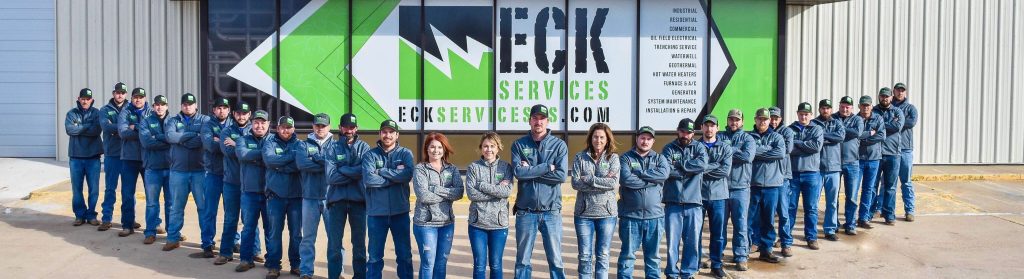
Licensed HVAC technicians dispatched from seven Kansas branches. We install natural gas, propane, and electric furnaces.
Wichita · Hutchinson · Salina · Pratt · Kingman · Anthony · Medicine Lodge
Why Homeowners Choose Eck
Serving South Central Kansas since 2004. Kansas Mechanical License #10071, Lennox Premier Dealer, BBB accredited A+, and named to the Inc. 5000 in 2019, 2020, and 2021.
- Every install sized by Manual J load calculation, not by matching the old unit
- Licensed in mechanical, electrical, and plumbing — venting, gas, and electrical handled in-house on one visit
- We install and service all major brands
- Permitted and inspected wherever the jurisdiction requires it
Don’t Say What the Heck, Call Eck!
Schedule a replacement evaluation online or call your nearest branch. Booking before the season gives the most flexibility on equipment and timing.
Schedule Online
Frequently Asked Questions
It comes from an ACCA Manual J load calculation — the ANSI standard and a code requirement in most jurisdictions — which accounts for square footage, insulation, windows, infiltration, duct losses, and design temperature. Rule-of-thumb sizing routinely oversizes by 30–50%, causing short cycling, uneven temperatures, and shorter equipment life. Anyone quoting a size without measuring the home deserves a second opinion.
Often yes, even if it still works. Furnaces and condensers are engineered as matched systems sharing the indoor coil, blower speeds, and refrigerant profile. Replacing one tethers it to the other’s limits and frequently breaks AHRI warranty matching. If the AC is past ten years or runs on R-22, replace as a pair.
Unlike most equipment decisions, this one has a hard stop in it: any evidence of a cracked heat exchanger or a carbon monoxide path ends the conversation regardless of the system's age. Short of that, three things decide it. An igniter, flame sensor, or control board on a system under about twelve years old is a repair. A heat exchanger failure, or most failures on a system past fifteen — ASHRAE puts median gas furnace life around eighteen years — points to replacement, particularly once parts start going obsolete. Between those, repair history is the tiebreaker: a second or third call in two winters is a pattern rather than bad luck. Worth knowing separately, by thirty years most furnaces run 60–70% AFUE against 90–98% for current equipment, so replacement typically cuts heating fuel use by 20–40%.